
RE Advisory: 2026 Top Technology Trends

AI has crossed a threshold: in 2026 it’s not a feature, it’s the operating model. Across our client work at RE Advisory (strategy through delivery) and research from Gartner, IBM, and other leading analysts, one theme keeps repeating: the winners won’t be the organizations with more tools. They’ll be the ones that can orchestrate intelligence, govern data and AI at scale, and operate securely in real time.
TL;DR (Executive Summary)
- Agentic AI + multi-agent orchestration becomes the default way work gets done.
- AI-native development and domain-specific models reshape software delivery and decision-making.
- Federated data governance and digital provenance become non-negotiable for trust, compliance, and reuse.
- Confidential computing, AI security platforms, and preemptive cybersecurity mature as board-level priorities.
- Edge AI + smart sensing networks + physical AI push autonomy into the real world (operations, supply chain, safety).
- AI sovereignty + geopatriation move from policy talk to architecture decisions.
- Quantum readiness becomes practical planning, not science fiction.
What makes 2026 different?
Gartner’s 2026 IT Symposium/Xpo messaging was clear: the “top strategic technology trends” are no longer just emerging innovations, they’re essential tools for resilience, intelligent operations, and protecting enterprise value.
IBM research adds an important layer: volatility isn’t just risk. Many leaders see it as opportunity. Especially if they can make decisions faster than conditions change. In IBM’s executive research (as captured in our notes), 74% of executives expect economic and geopolitical volatility to create new opportunities, and 90% believe they’ll lose competitive edge if they can’t operate in real time.
That’s the backdrop. Now the trends.
2026 Top 10 Technology Trends
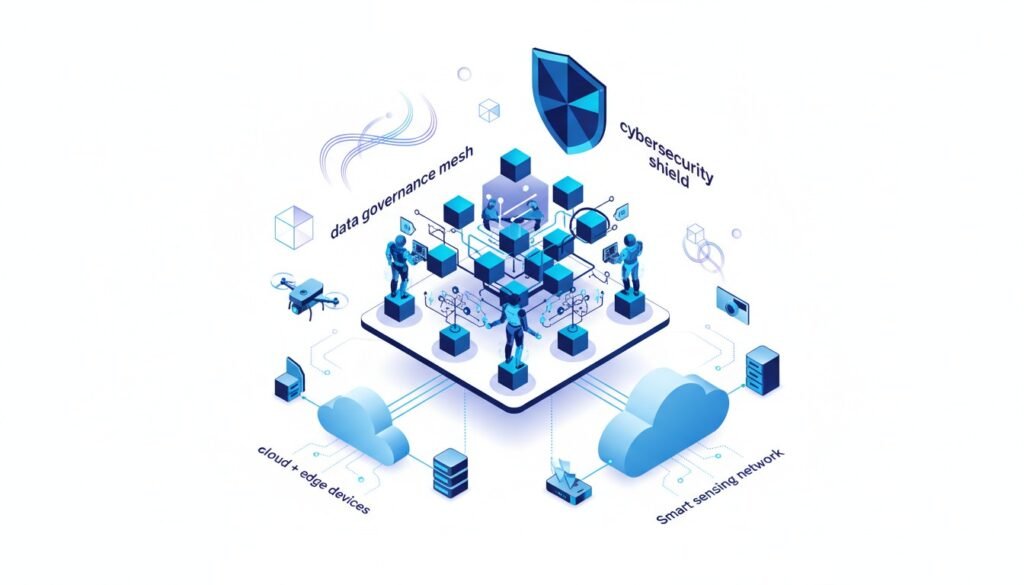
- Agentic AI and Autonomous Agents
Definition: AI systems that can reason, plan, and act across workflows, not just assist with tasks.Why it matters in 2026: “AI assistant” starts to sound dated. The shift is from copilots to end-to-end workflow owners (with human oversight). Our clients are already moving from isolated pilots to agent-based operating patterns in IT, finance, customer ops, and security.
Signals to watch: Agent “control planes” and monitoring become standard platform capabilities. Organizations formalize roles like Agent Owner, AI Workflow Architect, and Model Risk Lead.
What to do now: Pick 2–3 workflows with clear handoffs (e.g., intake → triage → resolution) and design human-in-the-loop guardrails from day one. -
Multi-Agent Orchestration (Ecosystems of Agents)
Definition: Coordinated teams of agents collaborating toward a shared goal (not just single-task bots).
Why it matters: As complexity rises, a single agent can’t reliably “own” the full problem space. Orchestration becomes the differentiator—routing, tool access, permissions, and conflict resolution between agents.
What to do now: Define an agent architecture: roles, boundaries, escalation paths, and auditability requirements. -
AI-Native Development Platforms
Definition: Software delivery platforms built around AI for planning, coding, testing, security scanning, documentation, and operations.
Why it matters: This is how teams move from “AI helped us write code” to “AI changed our delivery throughput and quality.” The best programs treat AI as part of the SDLC governance model, not a browser tab.
What to do now: Establish an AI SDLC policy: approved tools, data handling rules, secure prompts, and code provenance. -
Domain-Specific Language Models (DSLMs)
Definition: Models tuned to a specific domain (healthcare, insurance, real estate, legal, manufacturing) with domain data + controls.
Why it matters: Generic models can be impressive—but DSLMs are where organizations get repeatable accuracy, safer outputs, and measurable ROI.
What to do now: Build a domain data strategy: what documents, schemas,
ontologies, and “gold answers” define correctness? -
Federated Data Governance (Decentralized Ownership, Central Standards)
Definition: Domain-based ownership (often aligned to data mesh principles) with governance that can be automated.
Why it matters: AI amplifies every data weakness: inconsistent definitions, broken lineage, unclear ownership, and poor quality. Federated governance is how organizations scale speed and trust.
What to do now: Publish a minimum governance contract per domain: definitions, quality SLAs, lineage, access rules, and steward assignment. -
Digital Provenance (Trust, Lineage, and “Show Your Work”)
Definition: Verifiable origin and history of data, content, and AI outputs—what produced it, with what inputs, under what policy.
Why it matters in 2026: Customers and regulators want transparency. In our notes, two-thirds of consumers would switch brands if a company intentionally concealed AI’s involvement in the experience. Provenance also reduces internal friction: faster audits, safer reuse, less rework.
What to do now: Treat provenance as a product feature: label AI interactions, store model/version metadata, and retain evidence for decisions -
Confidential Computing (Protect Data-in-Use)
Definition: Hardware-backed protections that secure data while it’s being processed (not only at rest or in transit).
Why it matters: AI workloads increasingly mix sensitive data sources. Confidential computing supports collaboration and cloud adoption without forcing “lowest common denominator” security designs.
What to do now: Prioritize confidential computing for: regulated data, model training on sensitive corp data, and cross-entity analytics -
AI Security Platforms + Preemptive Cybersecurity
Definition: Security approaches that anticipate attacks using AI, defend AI systems themselves, and automate response.
Why it matters: 2026 is the year many leaders internalize “AI is both adversary and ally.” Attackers use AI to scale phishing, exploit discovery, and social engineering. Defenders must use AI to detect earlier and respond faster, without creating unmanaged autonomous risk.
What to do now: Add AI threat modeling to your security program (prompt injection, data exfiltration via tools, model poisoning, identity misuse).
– Create an AI security reference architecture: identity, segmentation, audit logs, evaluation, and incident response. -
Smart Sensing Networks + Edge AI (Real-Time Autonomy)
Definition: IoT with advanced sensors plus edge AI that enables decisions close to where data is generated.
Why it matters: The business pressure to operate in real time is rising (IBM research in our notes highlights this urgency). Edge AI cuts latency, reduces bandwidth costs, and improves resilience when connectivity is imperfect.
What to do now: Map “real-time decisions” and move them to the edge first (safety, quality, anomaly detection, routing, predictive maintenance) -
Physical AI (AI in the Real World)
Definition: AI systems that perceive, reason, and act in physical environments—robotics, autonomous systems, computer vision, and industrial automation.
Why it matters: Physical AI is where AI ROI becomes tangible: throughput, safety, uptime, and supply continuity. It also forces seriousness about governance: failures can be physical, not just digital.
What to do now: Start with constrained environments: warehouses, controlled production lines, facilities operations