

Email Deliverability Assessment: What It Is and Why It’s Critical for Inbox Placement

Email marketing only works if your emails reach the inbox. But many businesses unknowingly send campaigns that never get seen. Instead, those emails land in spam folders, promotional tabs, or get blocked entirely.
This is where an email deliverability assessment becomes essential.
An email deliverability assessment is a comprehensive evaluation of the technical, reputational, and content factors that determine whether your emails reach the primary inbox instead of spam. Without one, businesses risk losing revenue, engagement, and sender reputation.
This guide explains:
- What an email deliverability assessment is
- Why it matters for email marketing performance
- How deliverability audits work
- What issues they uncover
- How to improve inbox placement
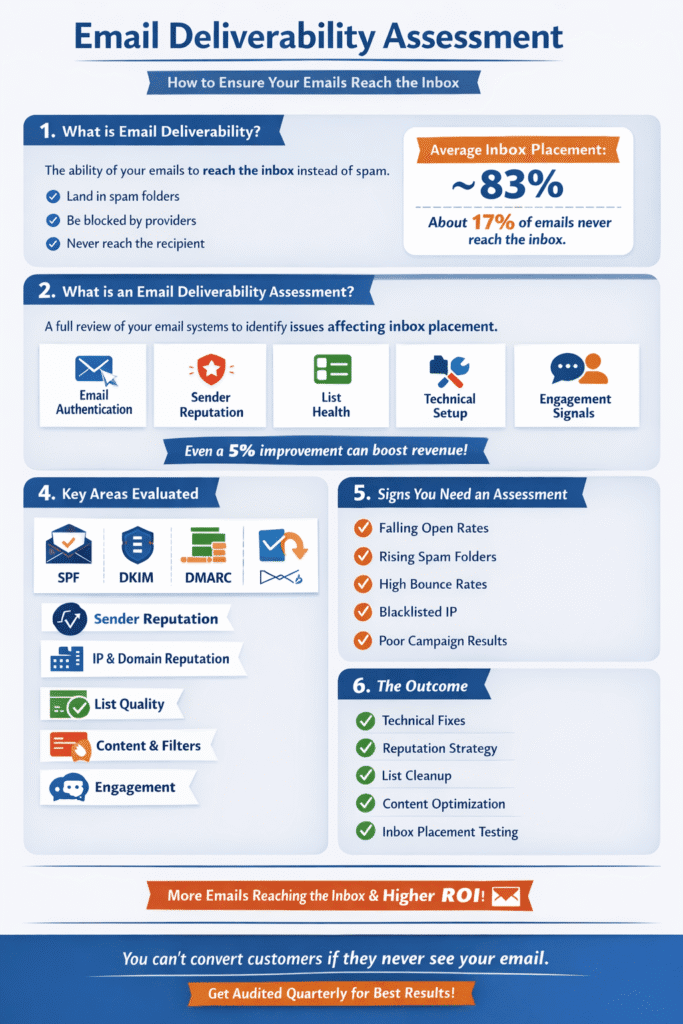
What Is an Email Deliverability Assessment?
An email deliverability assessment is a structured analysis of an email program designed to identify why emails fail to reach the inbox and how to fix those issues.
The assessment evaluates the entire email ecosystem, including:
- Sending infrastructure
- Domain authentication
- IP reputation
- Email content structure
- Email list quality
- Sender engagement signals
The goal is simple:
Maximize inbox placement and protect sender reputation.
When properly performed, a deliverability assessment reveals the hidden technical and behavioral factors that determine how mailbox providers like Google, Microsoft, and Yahoo classify your email.
Email Delivery vs Email Deliverability
Many marketers confuse delivery with deliverability, but they are very different.
Email Delivery
Email delivery simply means the receiving server accepted the message.
The email could still land in:
- Spam folder
- Promotions tab
- Junk folder
- Quarantine filters
Email Deliverability
Email deliverability measures where the email actually lands, especially whether it reaches the primary inbox.
High deliverability means:
- Strong inbox placement
- High engagement
- Healthy sender reputation
Poor deliverability leads to:
- Spam filtering
- Low open rates
- Lost revenue
This is why businesses focus on inbox placement rates, not just delivery rates.
Why Email Deliverability Assessments Are So Important
Email is one of the highest ROI marketing channels, but only if messages reach the inbox.
Industry studies estimate that 15–20% of legitimate emails never reach the inbox due to filtering and reputation issues.
A deliverability assessment helps businesses:
Protect Sender Reputation
Mailbox providers track sender behavior and assign a reputation score to domains and IP addresses.
Poor reputation leads to:
- Spam filtering
- Throttling
- Domain blocking
Improve Inbox Placement
Inbox placement determines whether recipients actually see your message.
Better placement means:
- Higher open rates
- Higher click rates
- Better campaign performance
Identify Hidden Technical Problems
Most deliverability issues are caused by technical configuration errors such as:
- Missing authentication records
- Blocklisted IPs
- Poor domain reputation
These problems are often invisible without a proper audit.
Prevent Revenue Loss
If emails land in spam, campaigns generate little to no return.
A deliverability assessment ensures that your marketing investment produces measurable results.
Signs You May Have Email Deliverability Problems
Many organizations don’t realize they have deliverability issues.
Here are common warning signs.
Sudden Drop in Open Rates
If open rates drop significantly, your emails may be landing in spam or promotional folders.
Rising Spam Complaints
When recipients mark emails as spam, mailbox providers reduce trust in your domain.
High Bounce Rates
Hard bounces indicate invalid email addresses and poor list hygiene.
Emails Landing in Promotions or Junk
Consistent filtering into secondary folders reduces visibility and engagement.
Blocklists or Blacklists
If your domain or IP appears on email blocklists, inbox placement will suffer immediately.
What an Email Deliverability Assessment Analyzes
A professional deliverability assessment evaluates three core areas:
- Infrastructure
- Content
- Sender reputation
- Email Infrastructure
Infrastructure refers to the technical foundation of email sending.
The assessment verifies that your authentication and server configuration follow best practices.
Key checks include:
- Sender Policy Framework (SPF)
- DomainKeys Identified Mail (DKIM)
- Domain-based Message Authentication Reporting and Conformance (DMARC)
- Reverse DNS configuration
- Sending IP configuration
- Domain age and trust signals
These authentication protocols confirm to mailbox providers that your emails are legitimate.
- Email Content and Structure
Mailbox providers analyze email content to determine spam risk.
A deliverability audit reviews:
- Subject line patterns
- HTML formatting
- Image-to-text ratio
- Number of links
- Redirected URLs
- Shortened links
- Broken links
- File size and code quality
The goal is to ensure your email resembles legitimate communication, not spam.
- Sender Reputation
Sender reputation is one of the most important deliverability factors. It is influenced by:
- Engagement rates
- Spam complaints
- Bounce rates
- Sending consistency
- Email list quality
Mailbox providers assign reputation scores to sending domains and IP addresses.
Low scores lead to aggressive spam filtering.
How to Perform an Email Deliverability Assessment
A complete deliverability assessment typically follows five steps.
Step 1: Define Deliverability Goals
Start by identifying performance benchmarks such as:
- Inbox placement rate
- Open rate
- Complaint rate
- Bounce rate
These metrics help determine whether deliverability issues exist.
Step 2: Evaluate Authentication and Infrastructure
Verify that authentication records are properly configured.
This includes:
- SPF validation
- DKIM signatures
- DMARC policy enforcement
- Domain configuration checks
Without proper authentication, mailbox providers may reject or filter your email.
Step 3: Scan for Blocklists and Reputation Issues
Check whether your sending IP or domain appears on known blocklists.
This step also evaluates:
- Sender reputation scores
- Historical complaint data
- Spam trap exposure
Step 4: Review Email List Quality
Poor list hygiene is one of the biggest deliverability killers.
The assessment evaluates:
- Invalid addresses
- Inactive subscribers
- Purchased lists
- Spam trap risks
Healthy lists are built through permission-based opt-ins and regular cleaning.
Step 5: Test Inbox Placement
Inbox placement testing simulates how mailbox providers process your emails.
Testing environments evaluate placement across major providers including:
- Gmail
- Outlook
- Yahoo
These tests reveal where emails actually land.
How to Fix Email Deliverability Problems
Once issues are identified, remediation begins. Common fixes include:
Implement Proper Authentication
Ensure SPF, DKIM, and DMARC are correctly configured.
A strong DMARC policy helps prevent spoofing and increases sender trust.
Clean Your Email List
Remove:
- Invalid addresses
- Hard bounces
- Long-term inactive subscribers
This improves engagement signals and protects sender reputation.
Send Emails Consistently
Large spikes in sending volume can trigger spam filters.
Maintain a predictable sending schedule to build trust with mailbox providers.
Improve Segmentation and Personalization
Sending highly relevant content increases engagement, which improves deliverability.
Segment audiences based on:
- interests
- engagement history
- purchase behavior
Best Practices for Maintaining Strong Email Deliverability
Deliverability requires ongoing monitoring.
Best practices include:
- Regular authentication checks
- Monitoring sender reputation
- Testing emails before sending
- Maintaining clean email lists
- Tracking engagement metrics
- Conducting periodic deliverability audits
Companies that actively monitor deliverability typically achieve significantly higher inbox placement rates.
When to Hire an Email Deliverability Expert
Organizations with large email programs often benefit from expert support.
Professional deliverability consultants provide:
- advanced inbox placement testing
- infrastructure diagnostics
- reputation monitoring
- remediation strategies
- ongoing deliverability optimization
This is especially important for businesses sending millions of emails per month.
Email Deliverability Assessment FAQ
What does an email deliverability assessment do?
It identifies technical, reputational, and content issues preventing emails from reaching the inbox.
How long does a deliverability audit take?
A full professional assessment typically takes one to two weeks depending on the complexity of the email infrastructure.
How often should deliverability assessments be performed?
Most organizations should perform a full assessment once or twice per year, with ongoing monitoring between audits.
What is a good inbox placement rate?
High-performing email programs aim for 90–98% inbox placement.
Final Thoughts: Why Deliverability Determines Email Success
Email marketing success depends on one simple factor:
Your emails must reach the inbox.
Even the best campaigns fail if mailbox providers block or filter your messages.
An email deliverability assessment ensures your email infrastructure, reputation, and content are optimized for maximum inbox placement.
By regularly evaluating deliverability, businesses can:
- increase engagement
- protect their sender reputation
- improve marketing ROI
- ensure their messages are actually seen